The new tax regime proposed by the Modi government may not have acceptance from all corners.
'Success will require political skill, not just economic expertise'

Sandeep Shanbhag, a chartered accountant and director of Wonderland Consultants, a tax and financial advisory firm, discussed the impact of Budget proposals in a chat with Rediff.com's readers.

The two governments have already set a target of increasing bilateral trade in goods and services to $500 billion.

Advocate Prashant Bhushan, who is one of the petitioners in the black money case, makes a case for the revelation of all the names of account holders that the government has submitted to the Supreme Court.

Harsh Roongta, Mahesh Padmanabhan, Anil Rego answer the most sought after questions on Budget Day.

Financial assets make a comeback as returns on physical assets falter.
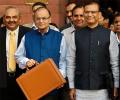
In an online chat with readers a few hours after the Union Budget 2015-16 proposals were announced by Finance Minister Arun Jaitley, Sundeep Agarwal, Director, PwC India, answered related queries to help put the announcements into perspective.

United States Secretary of State John Kerry, heading a high-powered delegation of his cabinet colleagues and top military commanders, today left for India as part of his 10-day seven nation Asia trip.

Similar traffic restrictions in other cities did not see a significant improvement in air quality only because car owners begin making more trips during their unrestricted periods. The other apprehension, as seen in other cities, is that residents have bought secondhand cars, using the other number plate so that they can continue to drive to their work place, thereby defeating the very purpose of this scheme.

'The voter thinks that the State is not going to impartially deliver services, provide justice, basic law and order, social insurance -- so as a voter it's very rational that I may choose a criminal who will help me navigate the State.' 'A weak State allows a criminal politician to be the person who provides that guarantee to mediate whatever problem the citizen has with the State.'

Indeed, Prime Minister Narendra Modi, who as Gujarat chief minister was considered close to certain business groups and industrialists, has hardly been seen with any Indian business head.

'When he first came to office, my belief is that the PM's reading of the landscape was that, with a vanquished Congress and fragmented Opposition, he was looking at least at two terms in office. This reading perhaps allows for a more cautious, gradual approach.' 'It was only a matter of time before the government was forced to come face-to-face with a serious corruption scandal. This is not a commentary on the BJP, but a statement about India's political economy.' 'There is growing concern about the government's commitment to freedom of expression, religious tolerance, and an independent civil society. Thus far, the positive movement on strategic and economic matters has crowded out these concerns, but they are lingering beneath the surface.'

The expansion in equity market volumes is driven by retail speculators indulging in heavy trading of complex derivatives that are economically unproductive, say Praveen Chakravarthy and T V Somanathan.
C K Ranganathan, CMD of the $12.50 billion CavinKare, in an interview with Shobha Warrier/Rediff.com, says though he sees signs of improvement everywhere, the Modi government has a long way to go to make the country business friendly

Unless the judges factor in the ungovernability of technologies and their beneficial owners, present and future Presidents, prime ministers, judges, legislators and officials handling sensitive assignments may become redundant with reference to their age-old roles for securing 'national resources and assets', warns Dr Gopal Krishna.

It was a multi-million rupee scam whose extent and reach are still being unravelled, so why did the chief of the scam-tainted Saradha group Sudipta Sen plead that he was unable to pay Rs 30,000 as bail fee? Where could all the money have gone? Indrani Roy finds out.

Car makers are cautiously optimistic, even as two-wheeler firms are clearly upbeat.

The Opposition on Monday charged the government with trying to promote crony capitalism, creating fear by giving "unbridled power" to taxmen, trying to snoop into people's lives through increased use of Aadhaar through the provisions of the Finance Bill.

FM should avoid proposals such as to tax financial transactions and fringe benefits

Do Modi's foreign visits actually serve India or they nothing more than expensive tools for domestic positioning and image-building, asks Shehzad Poonawalla.

'Let us also not expect that there will be a clean break with the past, much though the new government might like to think about it. In a functional democracy that is neither feasible nor desirable. But basic change it must be,' says Shreekant Sambrani.

Concluding the three-part series, Paranjoy Guha Thakurta says that the black money law is likely to fail because of the ineptness of India's investigative and enforcement agencies.

Pranab Mukherjee's book The Dramatic Decade: The Indira Gandhi Years takes the readers through the economic and social unrest of the period leading up to the emergency, rise and fall of leaders, many splits within the Congress, while promising to offer more in the next two volumes of the trilogy, says Nivedita Mookerji.

Finance Minister Arun Jaitley said the inflation index would determine the nominal growth figure, and it is better to set modest targets and outperform them.
Slow pace of reforms in India is disappointing: Faber

State after state has imposed an alcohol ban, and has had to retreat, unable to address the financial and administrative fallout. Are we set for more of this cycle, asks Aditi Phadnis.

Ramon Magsaysay winner Anshu Gupta, whose non-governmental organisation Goonj has been leading the relief efforts in Nepal which was ravaged by a devastating quake in April this year, speaks to Ankita Mishra.

'Alas, in this scheme there is nothing to stop the black money flows of the future.' 'On the contrary Modi has sown the seeds of more, through the issue of Rs 2,000 notes.' 'But have you heard one politician decrying this aspect of the scheme?' 'They must be secretly rejoicing that while Modi is taking away their past, he has not shut the door on their future,' says banker S Muralidharan.

Prime Minister Narendra Modi gave the vote of thanks to the President's speech on the opening day of the Budget session.

High savings, aggressive asset allocation and a frugal lifestyle can help you hang up your boots a decade early.

Contentious issues such as the construction of a Ram Temple in Ayodhya, abrogation of Art 370 giving special status to Jammu and Kashmir and enactment of Uniform Civil Code have been included in the Bharatiya Janata Party's election manifesto with the party making promises on them.

The industry's reactions to the Budget have been mixed.

Mohandas Pai took part in an hour-long chat on rediff.com
The most immediate cause of worry is the recent volatility in foreign exchange markets, Prime Minister Manmohan Singh tells the Assocham annual general meeting.

The government has provided a long-term vision.

Indian economy about to take-off
